Mike Teavee Is Sent by Television
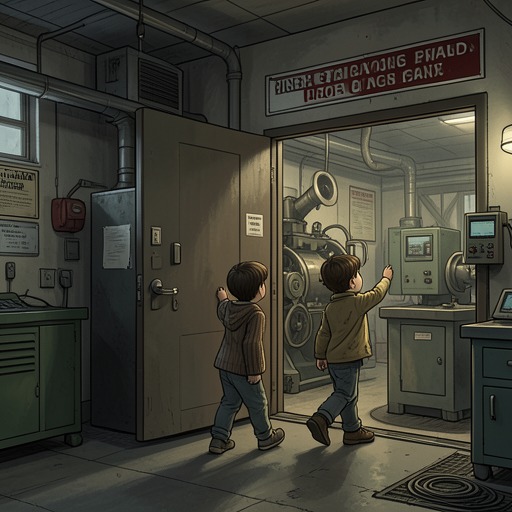
Charlie and the Chocolate FactoryMike Teavee Is Sent by Television is the decisive accident in the Television-Chocolate Room, where Mike Teavee ignores repeated warnings and uses Willy Wonka’s experimental transmitter on himself. The result is not death but a startling reduction of the boy into a tiny figure on a television screen, making his habitual absorption in televised violence physically visible and forcing his parents to confront the danger that Wonka’s inventions can conceal beneath their spectacle.
Background and Characterization
Mike Teavee arrives at the factory already defined by television. When reporters visit his home after he wins a Golden Ticket, he is nine years old and visibly irritated that anyone has interrupted his viewing. He sits before an enormous television set with his eyes fixed on a film in which gangsters shoot one another with machine guns. His attachment is not occasional entertainment: he says that he watches television every day, including programs without shooting, while expressing particular admiration for gangsters, gunfire, knives, and knuckledusters.
His costume makes the habit bodily and theatrical. Eighteen toy pistols of different sizes hang from belts around him, and he repeatedly jumps up to fire several of them. Mike therefore enters the factory as a child who treats mediated violence as an ideal form of life and who performs that fascination through his own gestures. His television addiction is not merely a preference announced in dialogue; it governs his attention, his posture, his speech, and his relation to other people. Questions and visitors become interruptions to the screen.
The Television Chocolate Experiment
In the Testing Room, Willy Wonka introduces Television Chocolate as his latest and greatest invention. He explains that television can break a photograph into millions of pieces, send those pieces through the air, and reassemble them elsewhere. His ambition is to apply the same process to a chocolate bar: the real object would travel in tiny pieces and be reconstructed at the receiving end, ready to eat.
Wonka’s first demonstration makes the experiment appear successful. Six Oompa-Loompas carry forward an enormous bar of chocolate, roughly the size of the mattress Charlie Bucket sleeps on at home. Wonka says it must be oversized because anything sent by television emerges much smaller than it was when it entered. When an Oompa-Loompa pulls down the large switch, a blinding flash occurs and the bar vanishes completely. At the other end of the room, the television screen flickers, brightens, and displays a small bar of chocolate.
The demonstration contains its own warning. Wonka explains that dangerous rays can break a person into a million tiny pieces in a second, which is why the Oompa-Loompas wear protective space suits. Mike Teavee is told to stand back because he is too close to the camera. Yet the successful transmission also creates the temptation that defeats the warning: the machine has visibly done what Wonka promised, and Mike hears Wonka admit that sending a person might be possible, though it could have nasty results.
Mike’s Decision and Disappearance
Mike responds to the possibility as if Wonka has offered him a personal challenge. The moment he hears that human transmission might be possible, he turns away and runs toward the great camera, declaring that he will be the first person sent by television. Willy Wonka, Mrs Teavee, and the others attempt to stop him, but Mike continues at full speed.
At the camera, he scatters Oompa-Loompas and leaps toward the switch. His farewell, “See you later, alligator!”, treats the experiment as another performance for an audience rather than as a physical danger. He pulls down the switch and jumps into the full glare of the lens. A blinding flash follows, then silence. The space that Mike occupied is suddenly empty, and the comic bravado of his approach gives way to his mother’s shock.
Mrs Teavee runs forward, stops in the middle of the room, stares at the place where her son had been, and screams, “He's gone! He's gone!” Mr Teavee confirms that Mike has disappeared. Willy Wonka places a hand on Mrs Teavee’s shoulder and says that they must hope Mike emerges unharmed at the other end. The experiment has shifted from a demonstration of commercial possibility into an uncontrolled test on a child.
Reappearance and Transformation
The receiving television does not immediately reveal Mike’s condition. Wonka adjusts a knob until the wavy lines disappear, and the screen gradually grows brighter. He then recognizes Mike’s image and announces that he is coming through. The delay sustains the uncertainty created by the machine: disappearance has been achieved, but successful reassembly remains in doubt.
A tiny voice comes from the television. Mike greets his parents and boasts that he is the first person ever sent by television. Mrs Teavee reaches into the screen and takes him out. Willy Wonka celebrates that Mike is in one piece and completely unharmed, but Mrs Teavee rejects that description as she examines the tiny boy running across her palm and waving his pistols.
Mike has emerged alive, yet the result is unmistakably a bodily reduction. He is no more than an inch tall. Mr Teavee identifies the obvious transformation—Mike has shrunk—and Wonka treats it as the expected consequence of television transmission. The earlier chocolate demonstration has therefore predicted the accident exactly: what enters the system comes out smaller. Applied to a child, the machine turns a technical principle into grotesque physical fact.
Consequences and Significance
The incident gives Mike’s television obsession a literal form. He previously wanted to inhabit the world of televised gangsters and treated the screen as more compelling than conversation; now the screen becomes the route through which his body is fragmented, transmitted, and reduced. His identity as a viewer is transformed into the condition of an image, while his toy guns remain part of the spectacle even after his body has become tiny.
The scene also places two opposing meanings of television beside each other. For Mike, television is an addictive source of excitement and violent fantasy. For Willy Wonka, it is a medium that can be engineered into a new method of transporting and selling chocolate. Wonka imagines viewers at home taking a chocolate directly from the screen after hearing an advertisement, so that television becomes both a technological channel and a mechanism for distributing desire. Mike’s accident reveals the darker version of that same fantasy: the medium does not merely deliver an object; it can seize and alter the body of the person who approaches it.
The episode’s value shift is consequently severe. The room begins in wonder, with the chocolate bar disappearing and reappearing as proof of invention. Mike’s impulsive intervention changes wonder into danger, disappearance into panic, and apparent success into grotesque survival. His reappearance restores life but not normality. The Oompa-Loompas’ later song, which declares that the most important lesson concerning children is never to let them “get near the television set,” turns the accident into a public moral lesson. Mike’s fate is therefore both a consequence of his own compulsive behavior and a warning about a technology that makes passive viewing, commercial seduction, and physical risk part of the same dazzling apparatus.